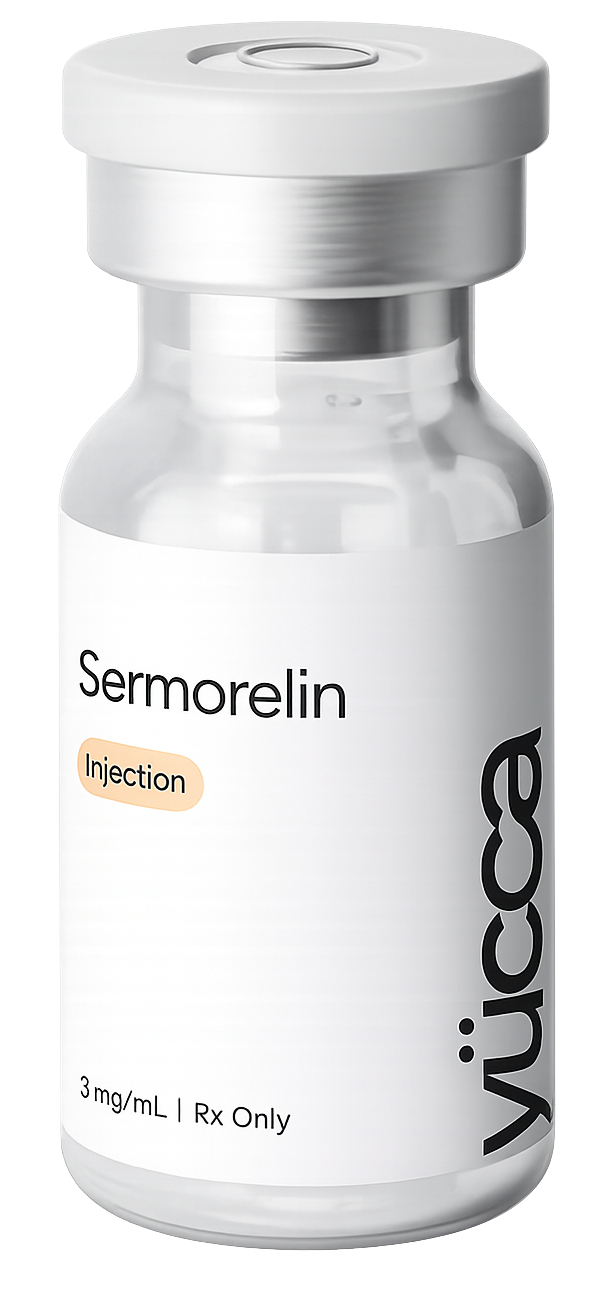
Sermorelin Injections — What You Need to Know Before Starting
Sermorelin acetate injections are one of the most clinically studied peptides for restoring natural growth hormone levels. Learn how to inject sermorelin, where to inject sermorelin, the right sermorelin injection dosage, and how to get started through a licensed online provider.
Prescription required. Online consultations available in most US states.
Prescription-Only Therapy Licensed US Physicians Shipped to Your Door Ongoing Lab Monitoring
The Basics
What Are Sermorelin Injections?
Sermorelin acetate is a synthetic analogue of growth hormone-releasing hormone (GHRH). Unlike synthetic HGH, sermorelin injections work by stimulating your pituitary gland to produce and release growth hormone naturally — a key distinction that makes it both safer and more physiologically appropriate for most adults.
Sermorelin peptide injections are administered subcutaneously (just beneath the skin), making them straightforward to self-administer at home once you’ve been trained by your provider. The injectable sermorelin form has the highest bioavailability compared to sublingual troches, nasal sprays, or oral tablets.
Adults typically pursue sermorelin injection therapy for age-related growth hormone decline — a natural process that accelerates after age 30.
Why injections over pills or troches? Sermorelin is a peptide — it breaks down in the digestive tract. Injectable sermorelin bypasses this entirely.
Delivery Methods
Sermorelin Injections vs Pills & Troches
Delivery MethodBioavailabilityConvenience
Sermorelin injectionsBestHighestAt-home
Sublingual trocheModerateEasy
Nasal sprayModerateEasy
Sermorelin pills vs injectionsLowestEasiest
Bioavailability comparisons are general estimates. Consult your provider.
Clinical Benefits
Sermorelin Injection Benefits
Sermorelin injection benefits build over weeks and months of consistent use.
Increased Energy & Vitality
Many patients on sermorelin therapy report higher energy levels within the first month.
Improved Sleep Quality
Sermorelin’s nighttime dosing amplifies the natural growth hormone pulse during deep sleep.
Body Composition Support
Sermorelin injections for weight loss shift the body toward fat metabolism while preserving muscle.
Cardiovascular Health
Some patients on sermorelin injection therapy see improvements in cholesterol profiles.
Skin & Recovery
Increased GH levels support collagen synthesis and tissue repair.
Cognitive Clarity
Long-term sermorelin injection users report improvements in mental focus and mood.
Administration Guide
How to Inject Sermorelin
Sermorelin subcutaneous injections are straightforward to self-administer.
1
Gather your supplies
You’ll need your sermorelin vial, syringes with a 29–31 gauge needle, alcohol swabs, and a sharps container.
2
Reconstitute if needed
Most sermorelin peptide arrives as a lyophilized powder. Swirl gently — never shake.
3
Draw your dose
Draw the prescribed sermorelin injection dosage as directed. Common starting doses are 200–500 mcg.
4
Prep the injection site
Clean the area with alcohol and let it dry. Pinch a small fold of skin.
5
Inject and dispose
Insert at a 45° angle and depress slowly. Dispose of the needle in a sharps container.
Timing tip: The best time to inject sermorelin is at bedtime on an empty stomach (no food for 2–3 hours prior).
Injection Sites
Sermorelin Injection Sites
Abdomen (most common)
1–2 inches to either side of the navel. The best place to inject sermorelin for most patients.
Outer thigh
A reliable sermorelin injection site if rotating sites. Avoid the inner thigh.
Lower back / flanks
The love handle area offers generous subcutaneous tissue.
Upper arm (with assistance)
Requires care to avoid injecting too deeply into muscle.
Always rotate sermorelin injection sites to prevent tissue buildup.
Dosing Reference
Sermorelin Injection Dosage & Schedule
Sermorelin injection dosing is individualized by a licensed prescriber based on your labs, symptoms, and goals.
ParameterTypical ProtocolNotes
Sermorelin injection dosage (starting)200–300 mcg/dayProviders start conservative and titrate up
Maintenance dose300–500 mcg/dayAdjusted based on IGF-1 labs
How often to inject sermorelinOnce dailySome use 5 days on / 2 days off
Best time to inject sermorelinBedtimeAligns with natural GH pulse
RouteSubcutaneous (sub-Q)Not intramuscular
Needle gauge29–31 gauge, ½ inchMinimizes discomfort
Typical cycle length3–6 months minimumBenefits of sermorelin injections emerge gradually
Sermorelin injection dosing information is for educational purposes only. Always follow your prescribing physician’s instructions.
Patient Experiences
What Patients Say About Sermorelin Injections
Results vary based on individual health status, sermorelin injection dosage, and consistency.
★★★★★
“I was skeptical at first, but the instructions made sermorelin injections simple. Within six weeks I was sleeping through the night.”
MK
Michael K.
Age 47 · 8 months on therapy
★★★★★
“The question ‘where do you inject sermorelin?’ — turned out the abdomen was easiest. Three months in and my energy is noticeably better.”
TL
Travis L.
Age 52 · Sermorelin + ipamorelin
★★★★☆
“I tried troches first. Switching to injectable sermorelin made a significant difference. The bioavailability is clearly better.”
RS
Rachel S.
Age 44 · Switched to sermorelin injections
Individual results vary. Sermorelin is a prescription medication; results depend on individual health factors.
Common Questions
Sermorelin Injections — FAQ
Answers to the most searched questions about sermorelin injection therapy.
Sermorelin is injected subcutaneously — just beneath the skin. The most common sermorelin injection sites are the abdomen (1–2 inches from the navel), the outer thigh, and the lower back. Rotate sermorelin injection sites with each injection.
Most sermorelin protocols call for a daily subcutaneous injection at bedtime. Some providers use a 5-days-on / 2-days-off cycle. Your prescriber will determine the sermorelin injection frequency.
Bedtime is the preferred injection time. The body naturally releases growth hormone in pulses during deep sleep, and injecting sermorelin before bed amplifies this natural cycle. Can you inject sermorelin in the morning? Yes, but it’s less optimal.
Injectable sermorelin has the highest bioavailability. Sermorelin is broken down by digestive enzymes when taken orally. For patients asking whether sermorelin tablets work as well as injections, the clinical consensus favors injectable delivery.
Common starting sermorelin injection dosages range from 200–300 mcg per day, titrating to 300–500 mcg. Sermorelin injection dosing is always individualized — never self-dose without provider guidance.
Most patients notice sleep improvements within 2–4 weeks of starting sermorelin injections. Energy improvements follow at 4–8 weeks. Body composition changes — such as sermorelin injections for weight loss — generally require 3–6 months.
Avoid food for 2–3 hours before and 30 minutes after. Elevated insulin suppresses GH release. Can I drink water after a sermorelin injection? Yes — staying hydrated is encouraged.
A brief stinging or burning sensation is normal with subcutaneous sermorelin injections. Using a fine 29–31 gauge needle and letting the solution reach room temperature helps reduce discomfort.
Common sermorelin injection side effects include mild injection site reactions (redness, itching), transient headache, flushing, and early water retention. Sermorelin injection site itching typically resolves on its own.
The cost of sermorelin injections varies by provider and dosage. Telehealth programs typically range from $150–$400/month. The cost of sermorelin injections is generally more accessible than synthetic HGH therapy.
Sermorelin is always injected subcutaneously (just below the skin). Can you inject sermorelin intramuscularly? It’s not the standard protocol and is not recommended without explicit prescriber guidance.
Ready to Start Sermorelin Injection Therapy?
Yucca Health connects you with licensed US physicians who specialize in peptide therapy. Online consultation, at-home sermorelin injections, and ongoing lab monitoring.